Aptera Completes Its First Solar Electric Vehicle for Customer Delivery Carlsbad, CA — November 19, 2026 — Aptera Motors Corp. (Nasdaq: SEV), a solar mobility
The flaw is the amount of energy collection from the solar panels on a car sized object will always be significantly lower than the energy needed for street legal weight making it a novelty. It can’t really scale up to a useful vehicle that primarily relies on solar panels.
This would also be true if the solar panels were 100% efficient, which makes it a flawed design.
I’m referring to the existence of things like signals, airbags, and other safety features ends up being required weight to be street legal. Not a set ‘street legal’ weight, just weight required to meet legal requirements.
On an ultralight vehicle that could take up a significant proportion of the weight.
Does weight really matter that much at speed? At least for biking, I got the impression that it was aerodynamics that dominate resistance after like 20mph. Weight should mostly just affect acceleration speeds, not energy (although if you end up going slower on average you’d have less air drag, so more weight I guess could incidentally save you energy in some cases?)
As you noted, stopping and starting are a huge portion of energy expenditure for vehicles, not consistent speeds. That’s where weight has the biggest impact.
Driving a limited range vehicle is likely to have a lot more stops and starts.
Why would it have more stops/starts taking the same route? Also, that only requires more energy if you break (in which case, you’d lose about 70% of that energy that you forcibly convert to heat and asthma). If you just stop pushing the accelerator when you need to stop, you can save like 75% of the energy loss compared to average drivers. Its wild watching people drive cars so inefficiently.
Gotcha, so you know that the primary mode of charging is the NACS port under the license plate cover, and the solar is supplemental to add to driving range, around 40 miles per day in optimal conditions?
Yes, I completely understand that this is a battery powered vehicle marketed as a ‘solar vehicle’ that gets a potential 10% increase in its projected 400 mile battery range as long as it in optimal sunlight for the entire day. That is a flawed design because it will never get the optimal 40 miles in the real world AND it would only get that potential extra power over the course of an entire day as long as it was driven at least 40 miles because the power has to trickle into some kind of storage as it isn’t fast enough to have any impact while driving.
Their magic goal is one that can do up to 1,000 miles. The extra mileage from the solar panels isn’t proportional because it isn’t going to be proportionally larger, it becomes less and less of an impact as the charging distance increases. The solar panels are a useless gimmick.
Leaving this kind of vehicle out in the sun to get that likely over estimated amount of charging means more sun damage and weathering, which isn’t great for vehicles. Especially for an over engineered design like this one with the wheels outside the main body.


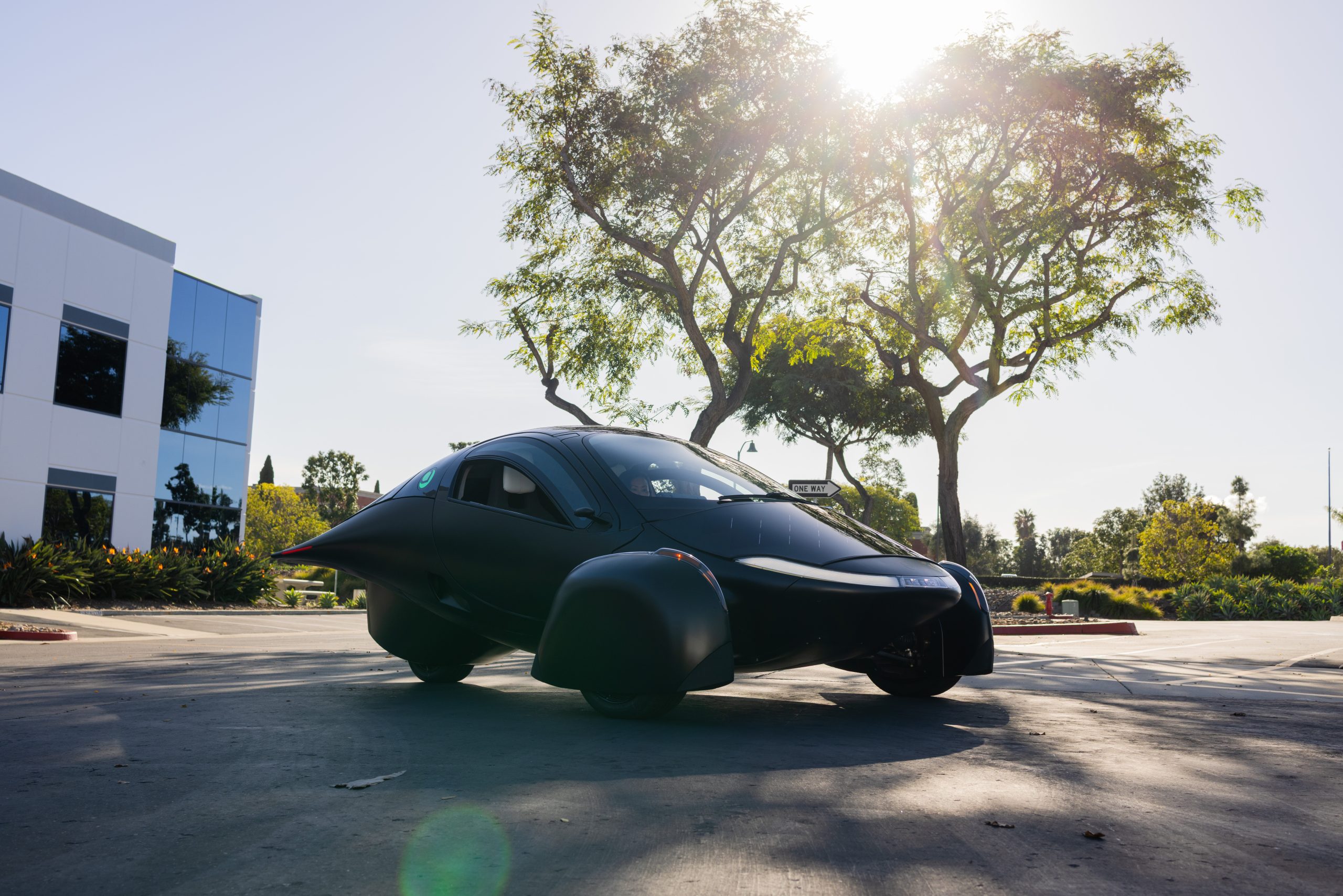
The flaw is the amount of energy collection from the solar panels on a car sized object will always be significantly lower than the energy needed for street legal weight making it a novelty. It can’t really scale up to a useful vehicle that primarily relies on solar panels.
This would also be true if the solar panels were 100% efficient, which makes it a flawed design.
What is this?
I’m referring to the existence of things like signals, airbags, and other safety features ends up being required weight to be street legal. Not a set ‘street legal’ weight, just weight required to meet legal requirements.
On an ultralight vehicle that could take up a significant proportion of the weight.
Does weight really matter that much at speed? At least for biking, I got the impression that it was aerodynamics that dominate resistance after like 20mph. Weight should mostly just affect acceleration speeds, not energy (although if you end up going slower on average you’d have less air drag, so more weight I guess could incidentally save you energy in some cases?)
As you noted, stopping and starting are a huge portion of energy expenditure for vehicles, not consistent speeds. That’s where weight has the biggest impact.
Driving a limited range vehicle is likely to have a lot more stops and starts.
Why would it have more stops/starts taking the same route? Also, that only requires more energy if you break (in which case, you’d lose about 70% of that energy that you forcibly convert to heat and asthma). If you just stop pushing the accelerator when you need to stop, you can save like 75% of the energy loss compared to average drivers. Its wild watching people drive cars so inefficiently.
Smells like a load of bullshit.
Definitely read about it before you come to an opinion on it.
I did…
I also understand the basics of solar power and how much energy it takes to move objects.
Gotcha, so you know that the primary mode of charging is the NACS port under the license plate cover, and the solar is supplemental to add to driving range, around 40 miles per day in optimal conditions?
Yes, I completely understand that this is a battery powered vehicle marketed as a ‘solar vehicle’ that gets a potential 10% increase in its projected 400 mile battery range as long as it in optimal sunlight for the entire day. That is a flawed design because it will never get the optimal 40 miles in the real world AND it would only get that potential extra power over the course of an entire day as long as it was driven at least 40 miles because the power has to trickle into some kind of storage as it isn’t fast enough to have any impact while driving.
Their magic goal is one that can do up to 1,000 miles. The extra mileage from the solar panels isn’t proportional because it isn’t going to be proportionally larger, it becomes less and less of an impact as the charging distance increases. The solar panels are a useless gimmick.
Leaving this kind of vehicle out in the sun to get that likely over estimated amount of charging means more sun damage and weathering, which isn’t great for vehicles. Especially for an over engineered design like this one with the wheels outside the main body.
The design is bad and they should feel bad.